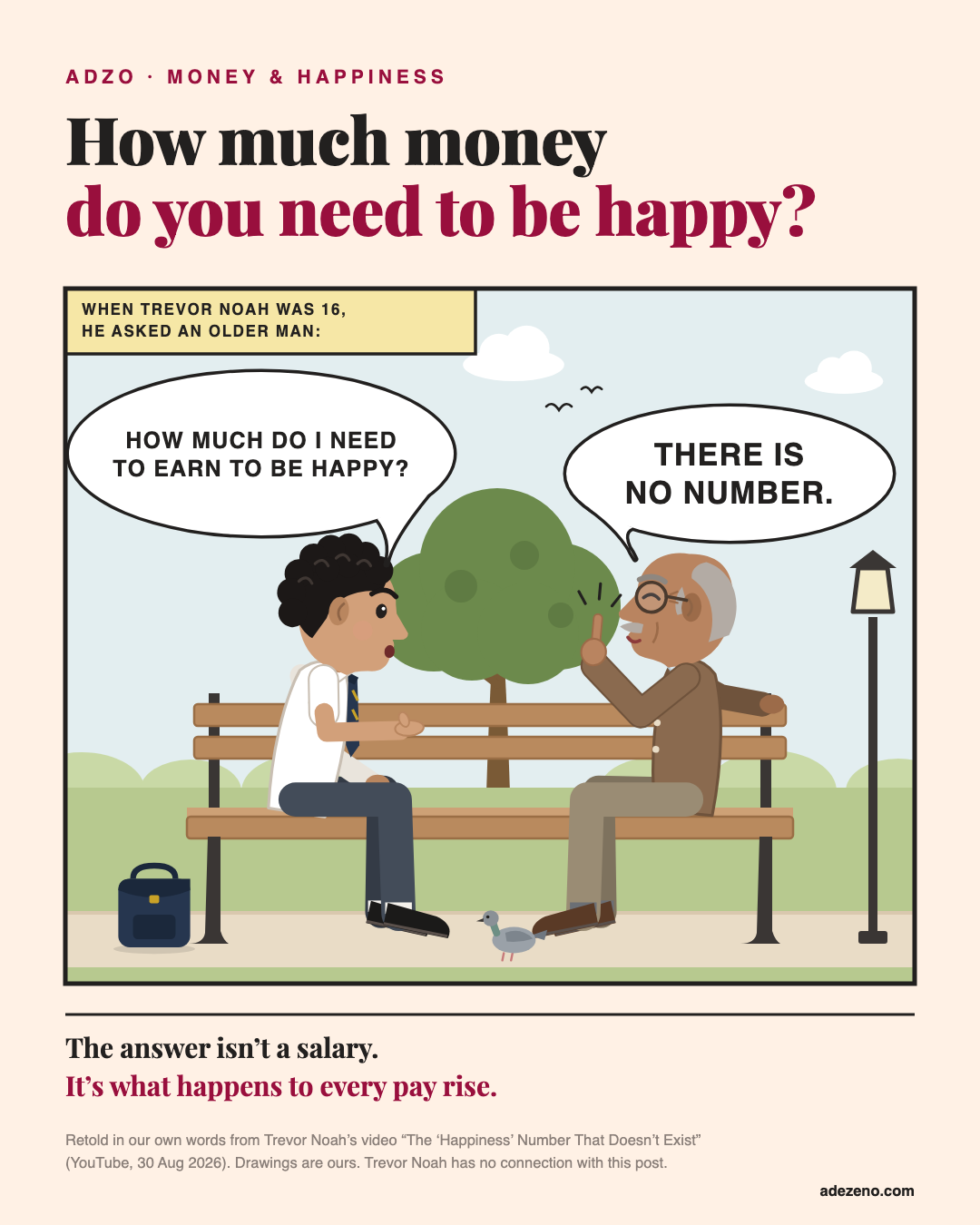
How much money do you need to be happy?
At 16, Trevor Noah asked an older man this question.
The answer: there is no number.
Here’s why. And what to do instead.
Source: Trevor Noah, “The ‘Happiness’ Number That Doesn’t Exist”, YouTube, 30 Aug 2026. Retold in our own words.
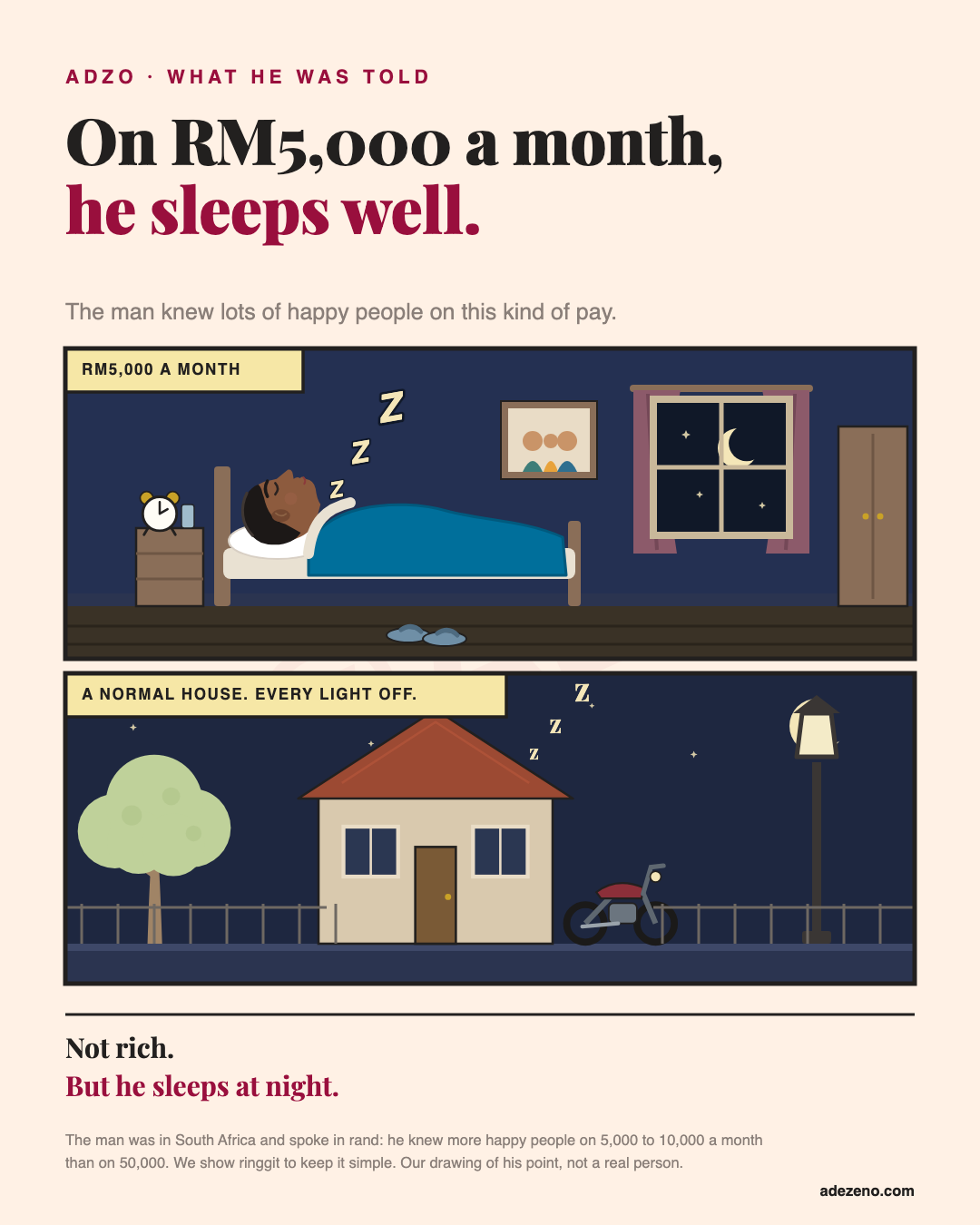
On RM5,000 a month, he sleeps well.
The man knew lots of happy people on 5,000 to 10,000 a month.
A normal house. Every light off. Fast asleep.
Source: the same video, 0:12–0:37. The man was in South Africa and spoke in rand; we show ringgit to keep it simple.
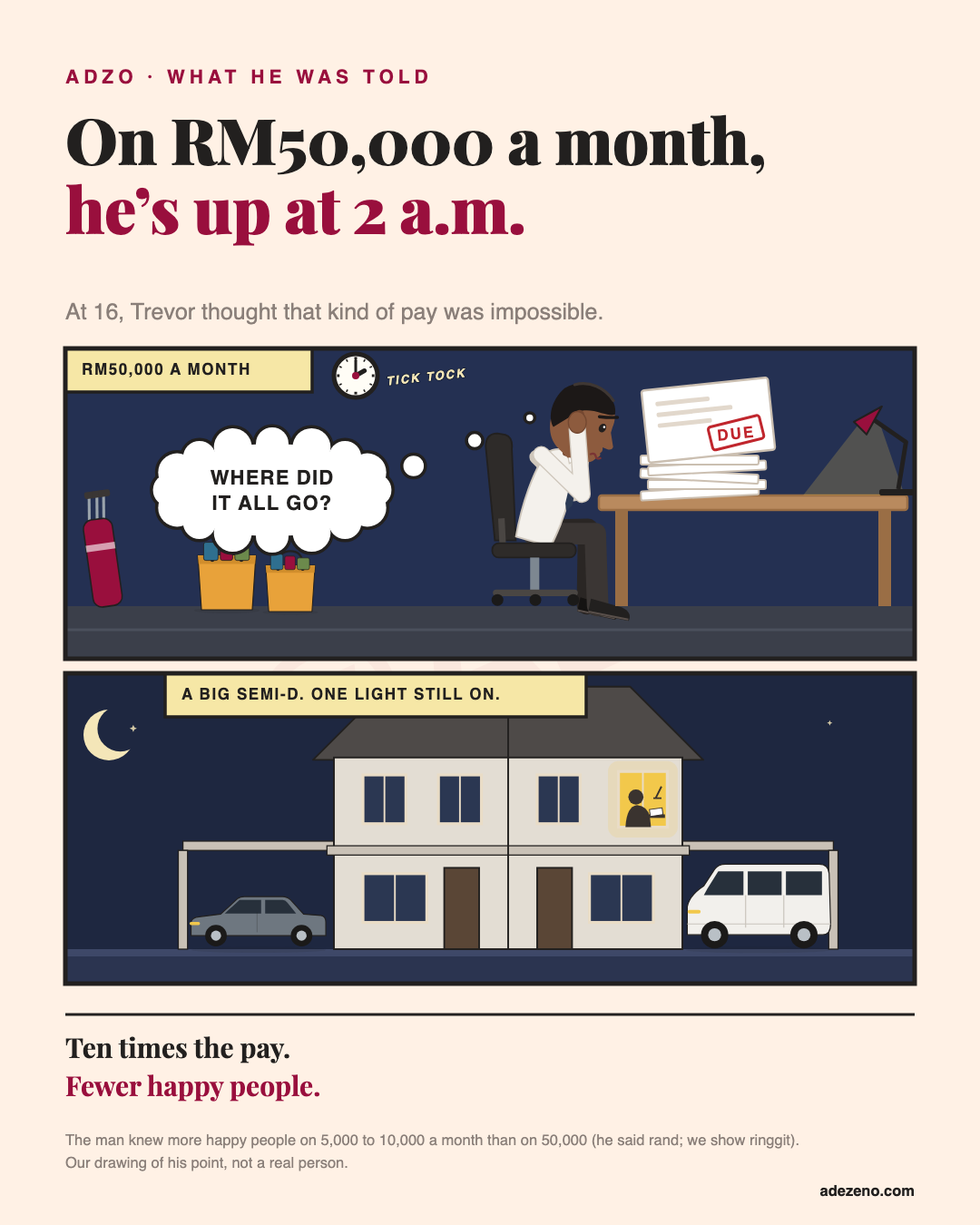
On RM50,000 a month, he’s up at 2 a.m.
He earns ten times more.
But the man knew fewer happy people on this kind of pay.
At 16, Trevor thought pay like that was impossible.
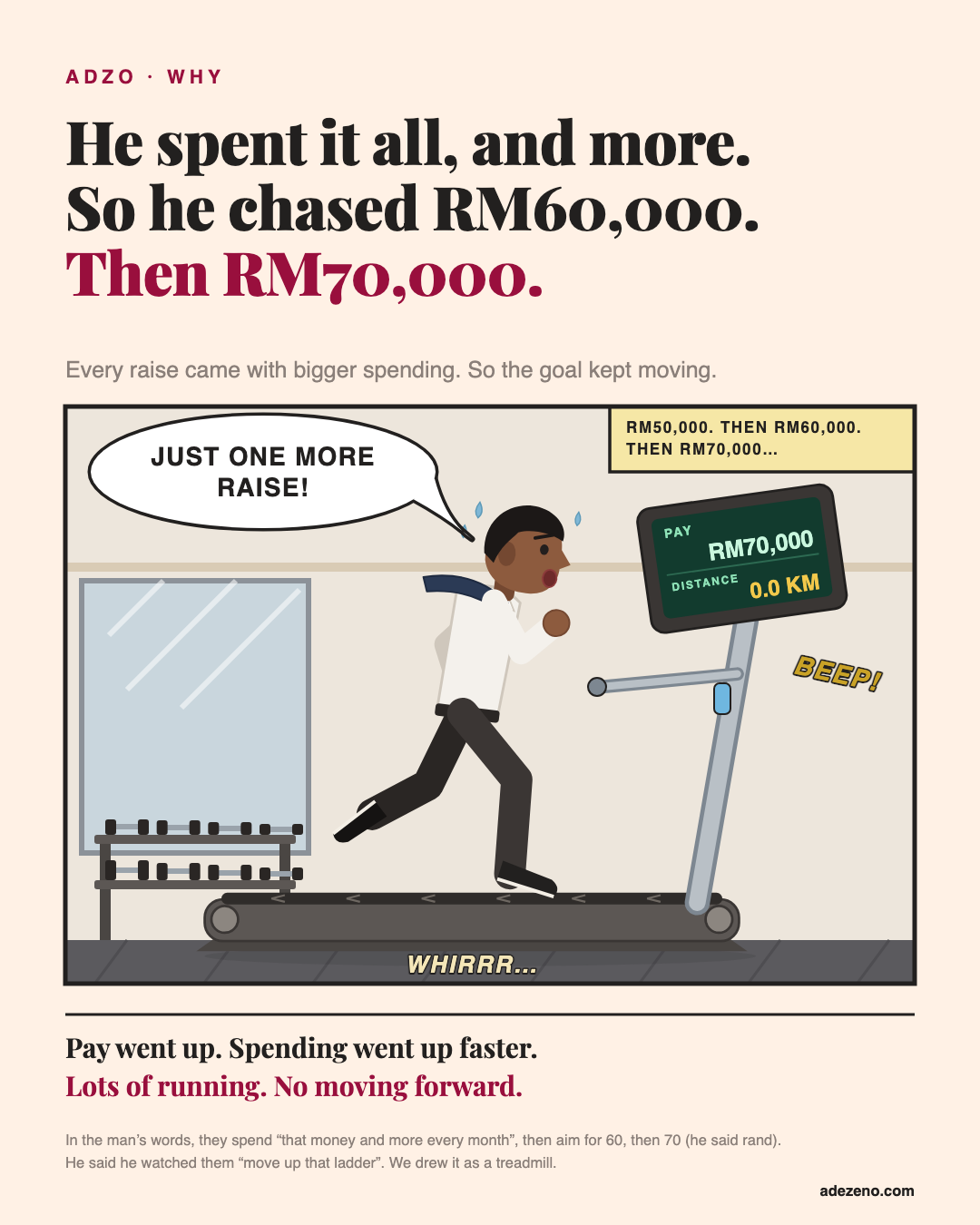
He spent it all, and more. So he chased RM60,000. Then RM70,000.
Every raise came with more spending.
So the goal moved. Then it moved again.
Lots of running. No moving forward.
Source: the same video, 0:38–0:52. The man called it moving “up that ladder”. We drew a treadmill.
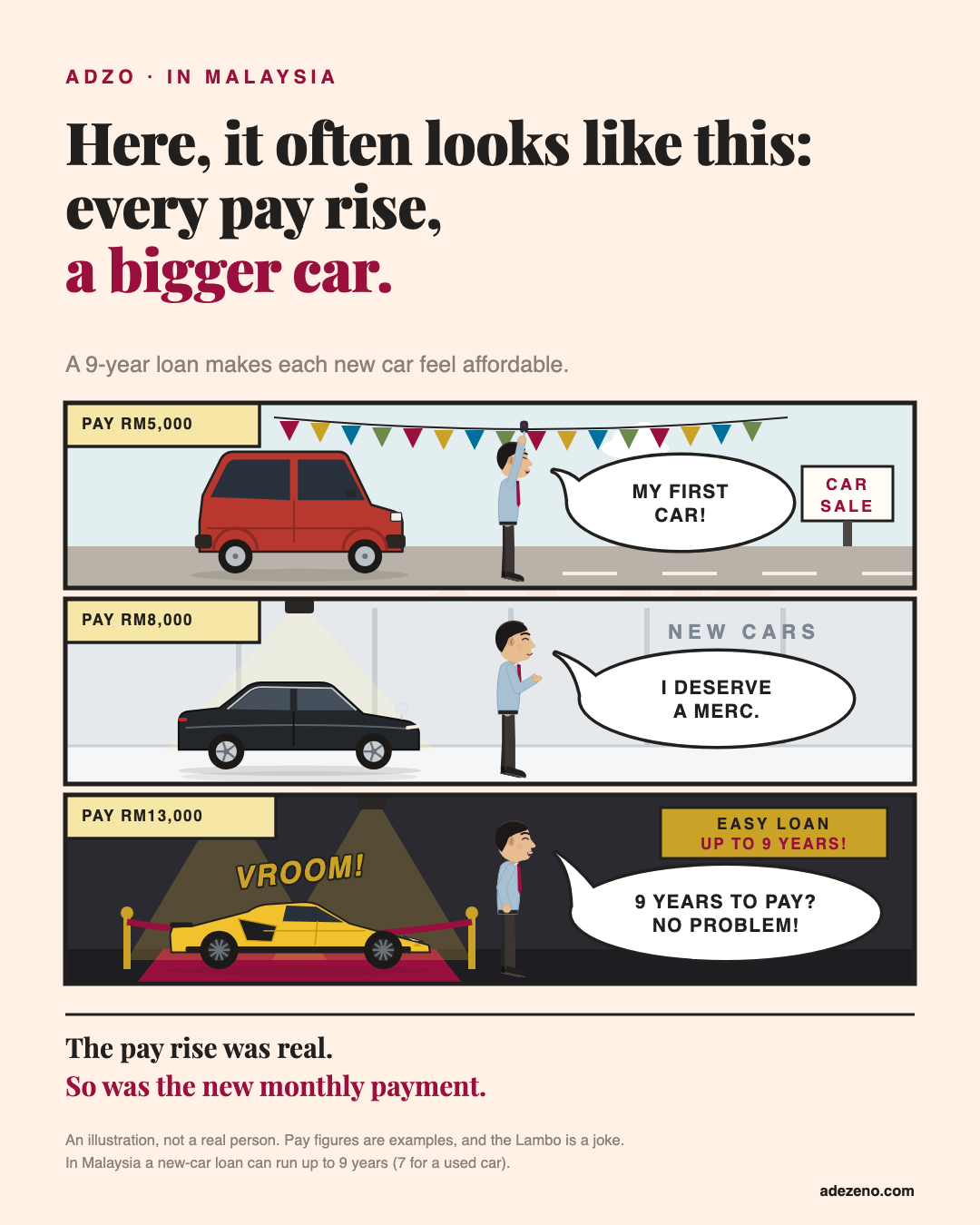
Here, it often looks like this: every pay rise, a bigger car.
A raise comes. A bigger car follows.
A Kancil, then a Merc, then a Lambo, each on a loan of up to 9 years.
Okay, the Lambo is a joke. The habit isn’t.
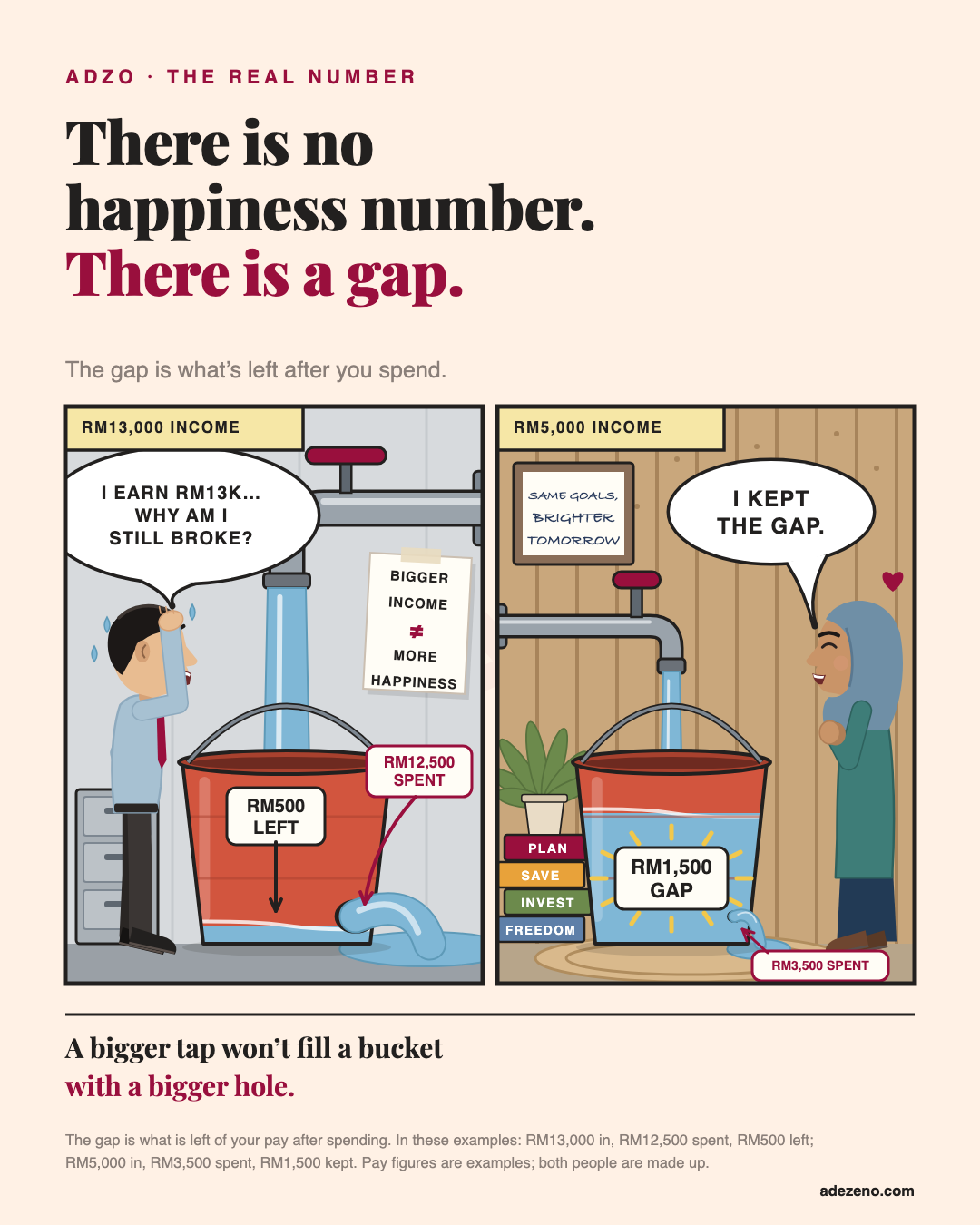
There is no happiness number. There is a gap.
He earns RM13,000 but spends RM12,500. Only RM500 is left.
She earns RM5,000 and spends RM3,500. She keeps RM1,500.
So watch the gap, not the salary.
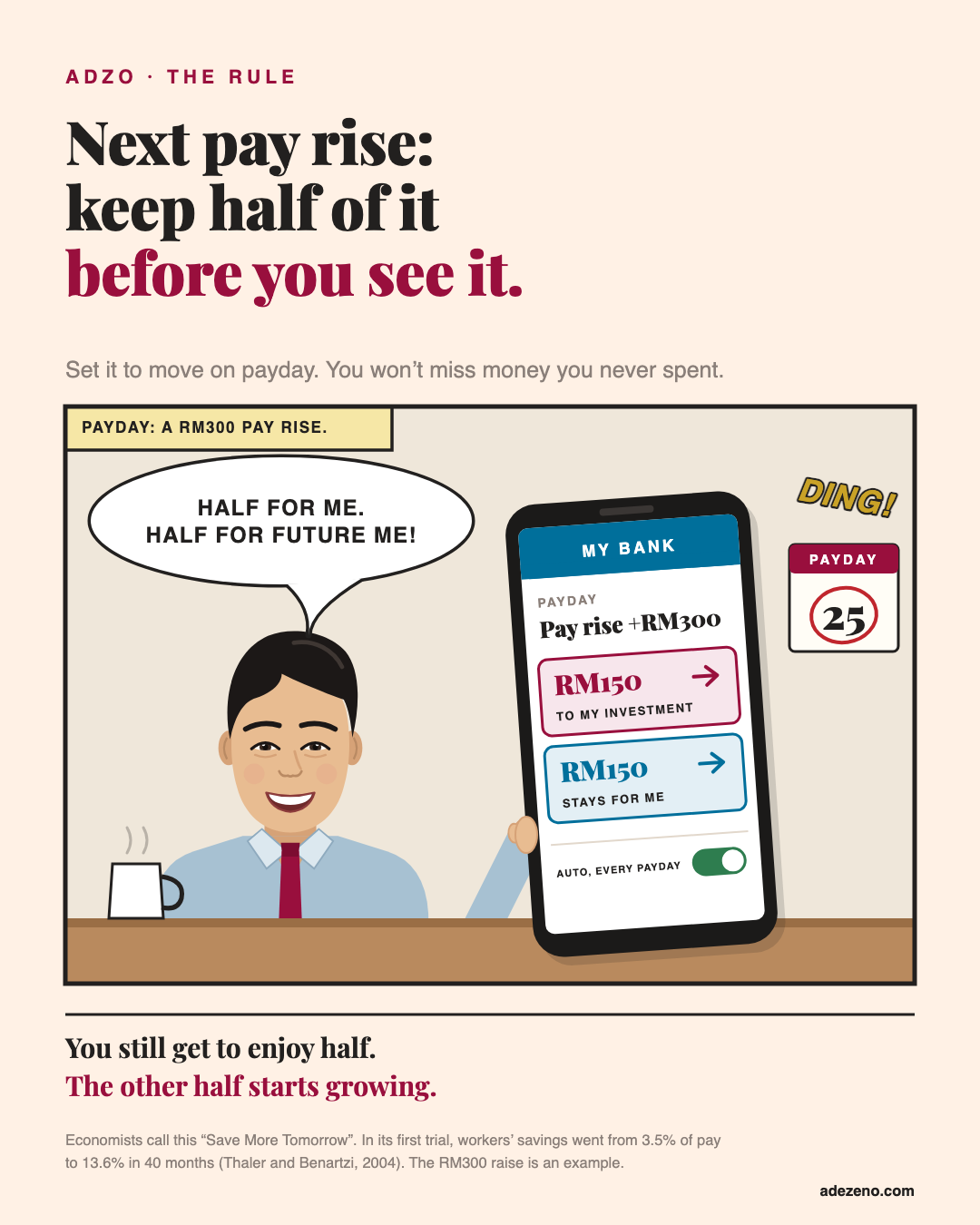
Next pay rise: keep half of it before you see it.
Say your pay goes up RM300.
Enjoy RM150. Move RM150 away on payday, automatically.
You won’t miss money you never spent.
Source: Thaler and Benartzi, “Save More Tomorrow”, Journal of Political Economy, 2004. Savings went from 3.5% to 13.6% of pay in 40 months.
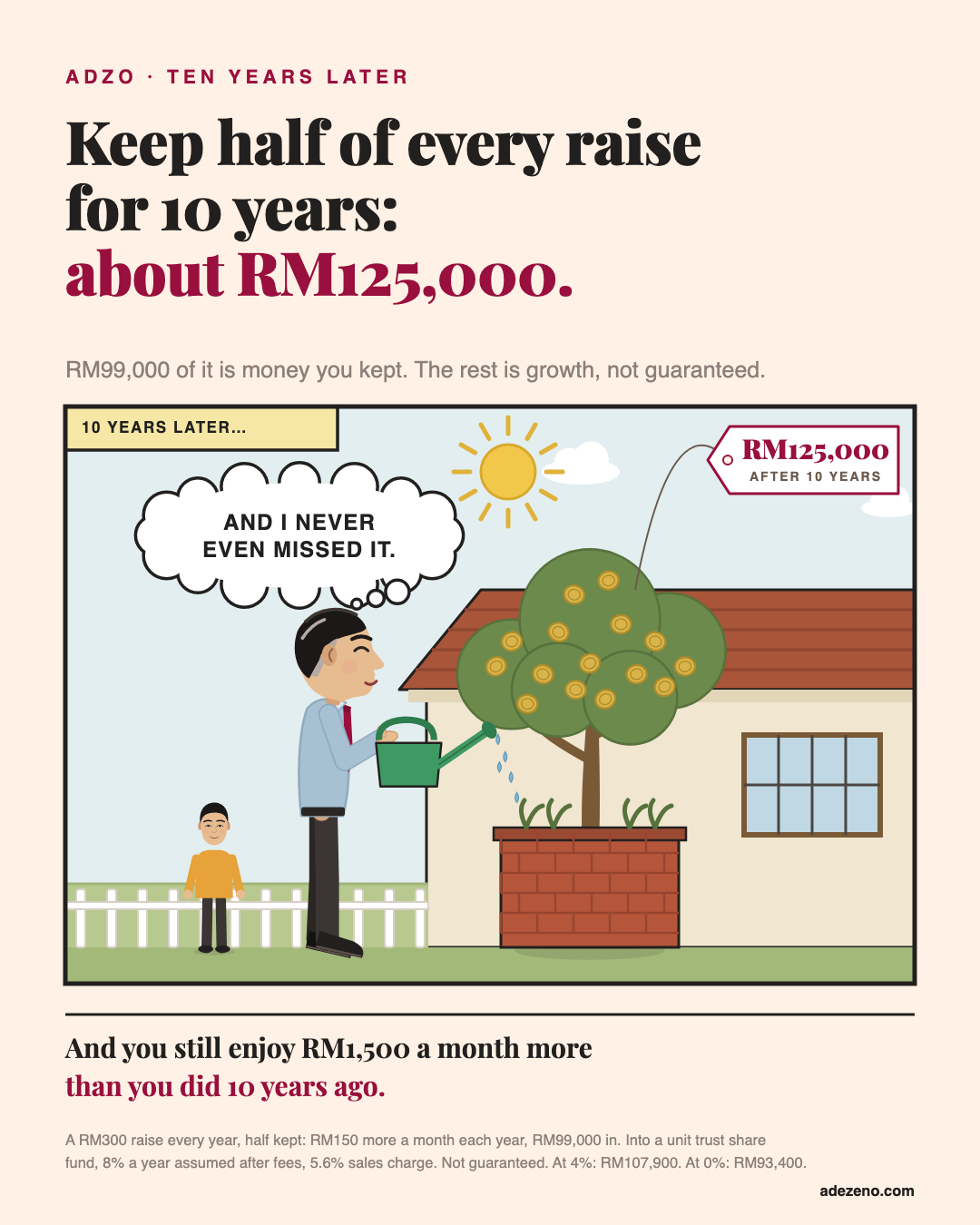
Keep half of every raise for 10 years: about RM125,000.
Do it every year for 10 years.
You’d put away about RM99,000. Growing at 8% a year, it could be about RM125,000.
And you still enjoy RM1,500 a month more than before. That’s what a small monthly amount can do.
Illustration: RM150 more a month each year into a unit trust share fund, 5.6% sales charge, 8% a year assumed after fees. Not guaranteed. At 4%: about RM107,900. At 0%: about RM93,400.
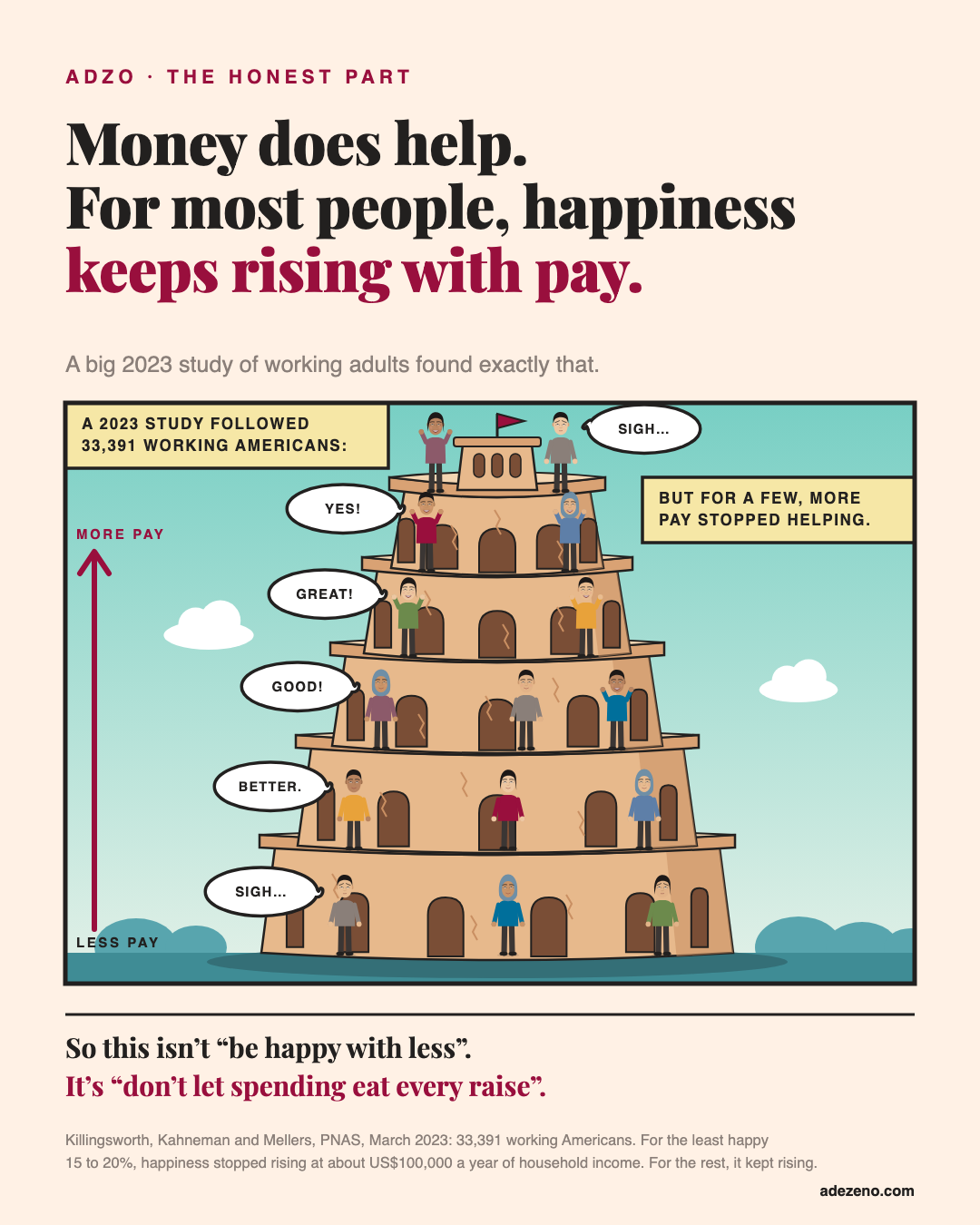
Money does help. For most people, happiness keeps rising with pay.
A big 2023 study followed 33,000 working Americans.
For most, more pay meant more happiness. For a few, it stopped helping.
So this isn’t about living on less. It’s about not letting spending eat every raise.
Source: Killingsworth, Kahneman and Mellers, “Income and emotional well-being: A conflict resolved”, PNAS, 2023. For the least happy 15–20%, happiness stopped rising at about US$100,000 a year.
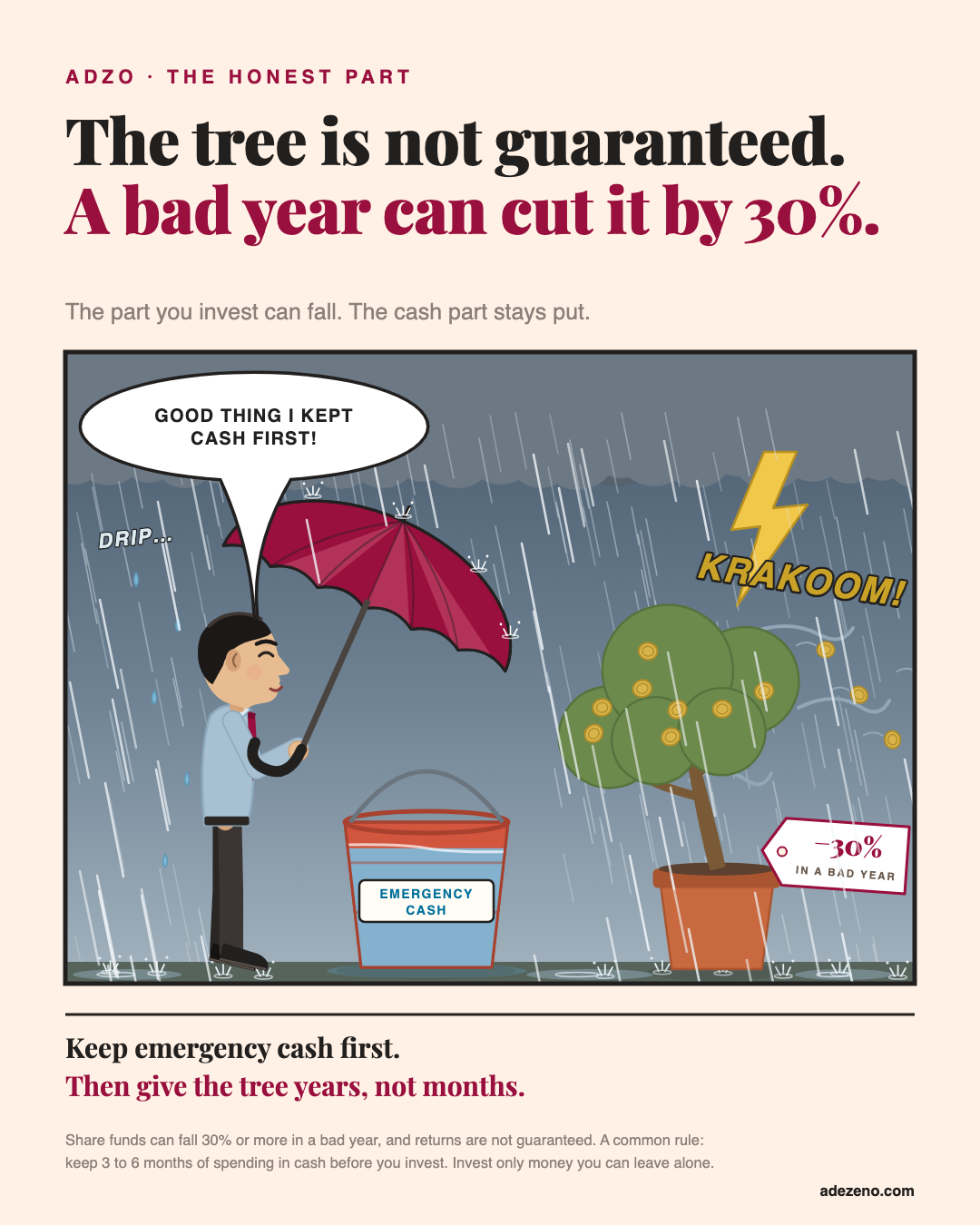
The honest part: the tree is not guaranteed. A bad year can cut it by 30%.
Invested money can drop a lot in a bad year.
So keep emergency cash first: 3 to 6 months of spending.
What to do when your fund falls is a story of its own.
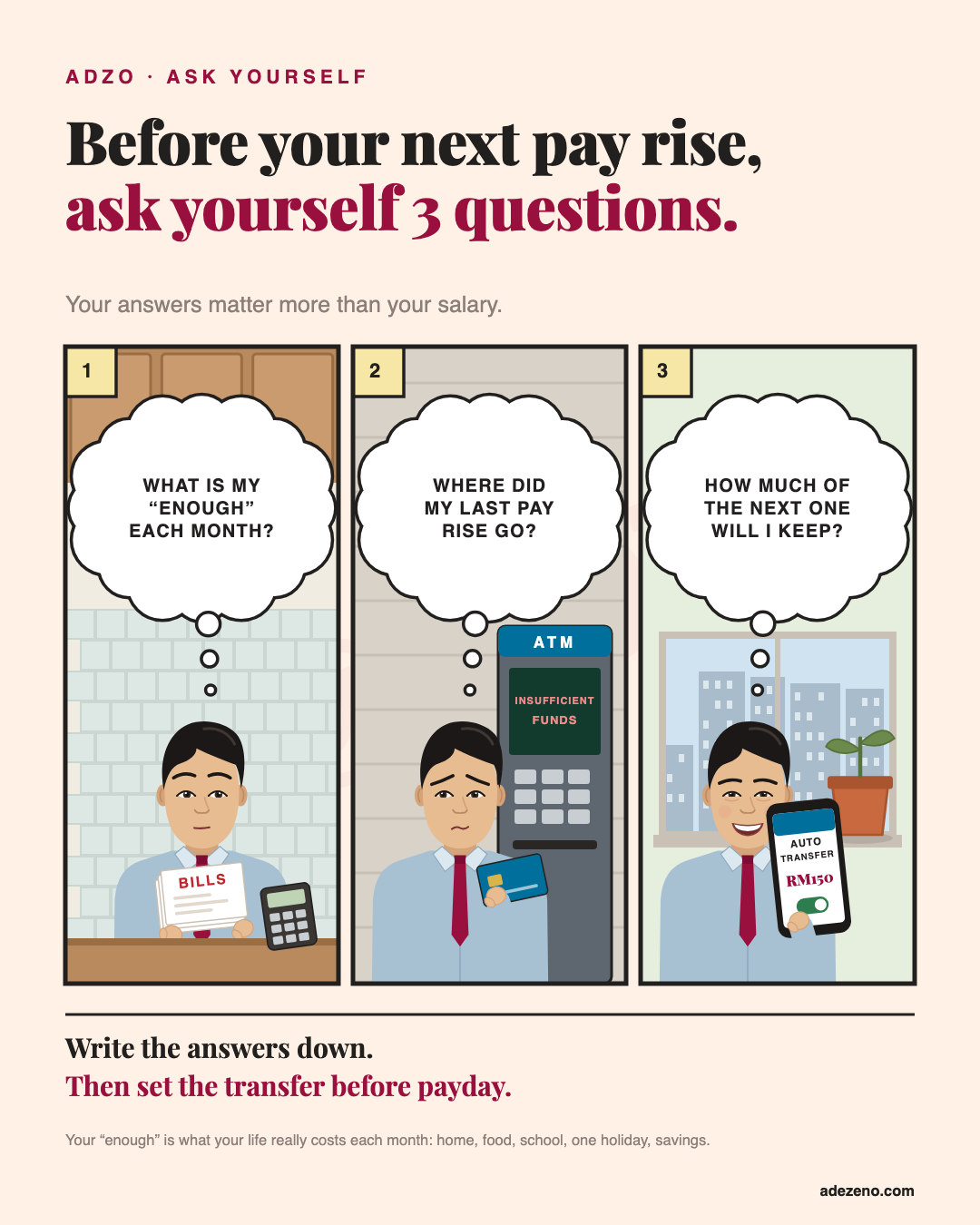
Before your next pay rise, ask yourself 3 questions.
1. What is my “enough” each month?
2. Where did my last pay rise go?
3. How much of the next one will I keep?
Write the answers down before payday.
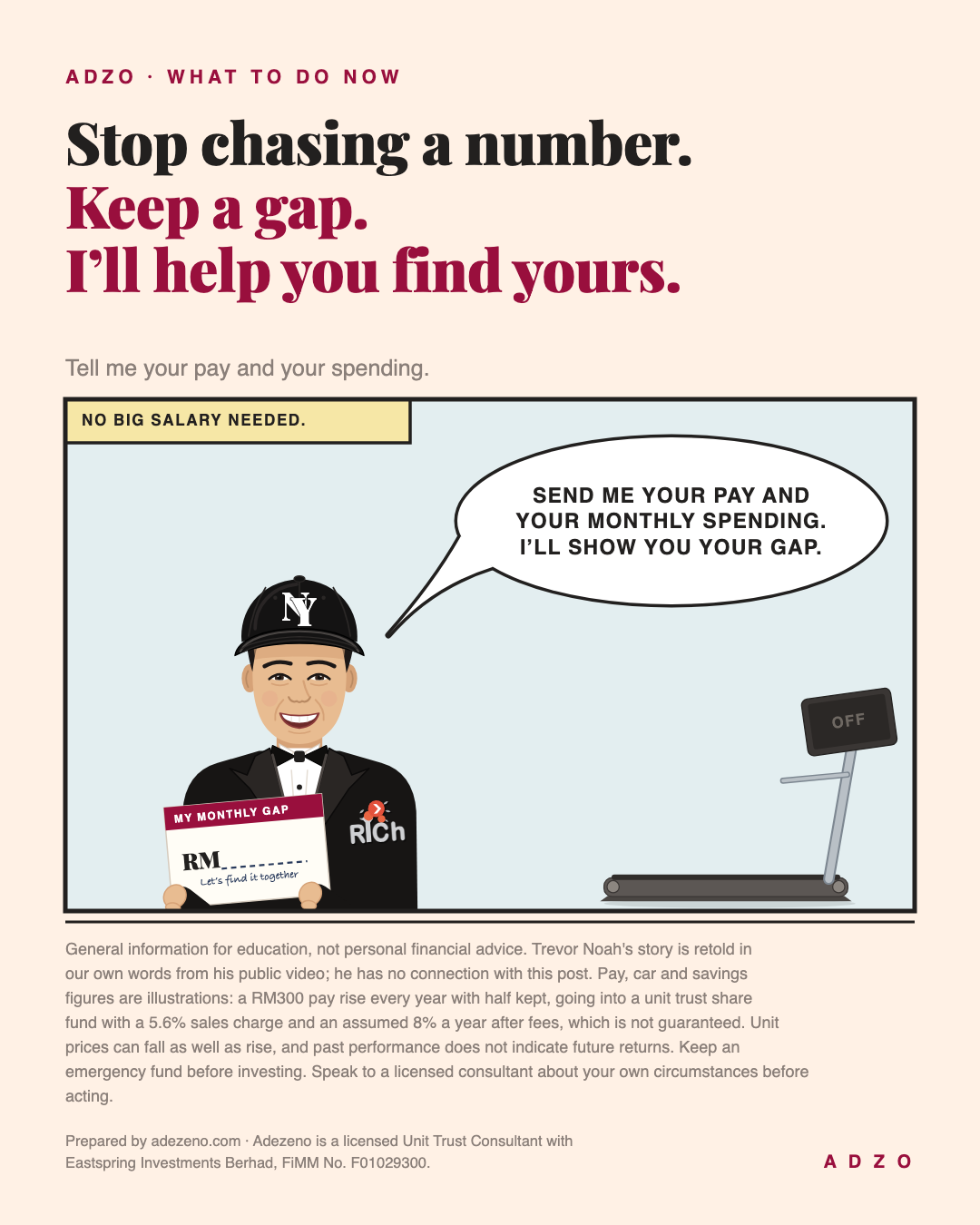
Stop chasing a number. Keep a gap. I’ll help you find yours.
Tell me your pay and your spending.
I’ll show you where your gap is, and how to grow it.
No big salary needed.
Find my gap on WhatsApp → Or work out your own runwayThis is general information for education, not personal financial advice. Trevor Noah’s story is retold in our own words from his public video; he has no connection with this post. The pay, car and savings figures are illustrations: a RM300 pay rise every year with half kept, going into a unit trust share fund with a 5.6% sales charge and an assumed 8% a year after fees, which is not guaranteed. Unit prices can fall as well as rise, and past performance does not indicate future returns. Keep an emergency fund before investing. Speak to a licensed consultant about your own circumstances before acting. Adezeno is a licensed Unit Trust Consultant with Eastspring Investments Berhad, FiMM No. F01029300.